Glucosepane
No enzyme makes it and no enzyme has ever been published that unmakes it. Glucosepane, the most abundant crosslink in aging human collagen, assembles itself at body temperature and has outlasted every tool built to break it.
Booking photographs
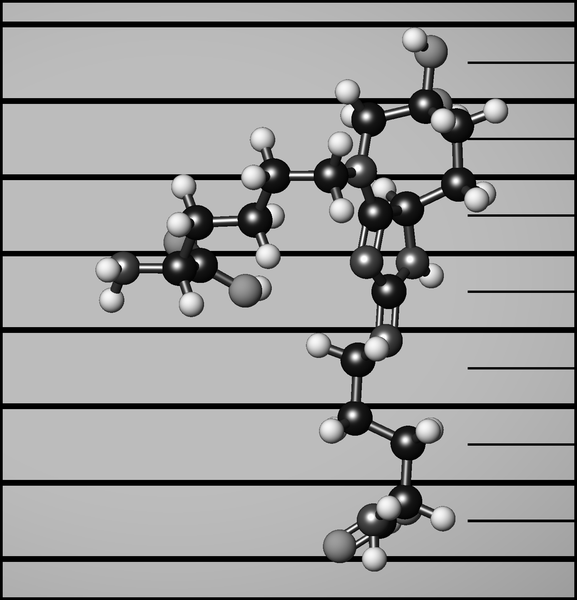
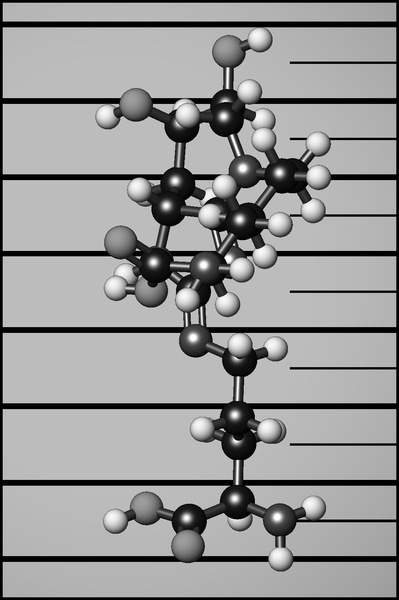
The suspect, from its real atomic coordinates. Drag to turn it. Height chart in nanometers, ruled every 0.1 nm. A collagen molecule is about two hundred times longer.
Rap sheet
- Self-assembly without a license: glucose plus a lysine plus an arginine, minus four waters, no enzyme, no oxidation.
- Monopoly: about 2,000 pmol per mg of 90-year-old skin collagen, against 30 and 15 for the next two crosslinks measured.
- Evading detection: it does not survive the hot-acid hydrolysis that standard protein assays begin with.
- Resisting reversal: as of 2026, nothing published breaks it.
- Suspected of stiffening aging tissue (the literature says it 'may compromise tissue elasticity'; the jury is still out).
- Answers to
- Glucosepane. One of the AGEs.
- Height
- 1.4 nm, curled up.
- Weight
- 0.71 zeptograms
- Build
- A glucose ring stapling a lysine to an arginine.
- Habits
- Self-assembles at body heat by shedding four waters.
- Rank
- The top crosslink in aging collagen, by far.
- Status
- Nothing known can undo it. It retires with its collagen.
- Last seen
- In the skin and bones of everyone reading this.
- M.O.
- Glucose glycates a lysine (an Amadori product), an arginine side chain comes within reach, and a series of water eliminations closes a seven-membered ring that welds the two side chains together. It needs no enzyme and no oxygen, only time at 37 degrees, so it accumulates wherever collagen lives long enough.
- Associates
- glucose, the accomplice; lysine and arginine, the two side chains it ties together; collagen, the long-term host (adult cartilage collagen is essentially never replaced); MODIC and GODIC, the runner-up crosslinks, at 30 and 15 pmol/mg; CML, a sugar adduct (not a crosslink) that an engineered enzyme could finally strip in 2026
- Priors
- Caught forming in a warm flask of glucose, lysine and arginine in 1999 (the discovery paper). First total synthesis in 2015: eight steps, 12% overall, the Crossref record listing SENS Foundation as the funder. First antibodies against it in 2020; first aptamer stain in 2025.
of them in a milligram of skin collagen at ninety, on average.
You’ve never seen one.
“Twenty-seven years on this case, and the best evidence we have is that our best tools can't touch it.” — Keltar, on the case
The remediation project: wanted, an enzyme that makes it let go
Breaking glucosepane is one of the clearest repair jobs in the biology of aging: an inert crosslink that piles up in long-lived collagen and that the body has no enzyme to remove. Glycation is the protein modification with no enzyme on either side: of the more than 600 known modifications, most are installed and removed by enzymes, but glycation has no 'writer', and whether humans have deglycases that broadly erase advanced glycation products is still disputed (Nat. Chem. Biol., 2025).
The first generation of 'AGE breakers' did not do it. The title of a 2003 paper says it all: 'AGE-breakers cleave model compounds, but do not break Maillard crosslinks in skin and tail collagen.' They cut sugar-derived alpha-diketone bridges, and glucosepane has none: it is a ring formed by water elimination. Later chemistry showed the best known of them works as a scavenger of reactive dicarbonyls, and a year-long study in healthy 70-year-olds found it did not reverse the vascular effects of decades of sedentary aging (Exp. Gerontol., 2013).
SENS Research Foundation made extracellular crosslinks one of its seven repair strands (the 'GlycoSENS' programme) and paid for the 2015 total synthesis, which finally gave researchers pure glucosepane to test against. That made antibodies (2020), a fluorescent aptamer stain (2025) and blood measurements possible. (LysoSENS, sometimes mentioned in the same breath, is a different strand: microbial enzymes against junk inside cells, such as lipofuscin; it proposed screening microbes for enzymes that eat the target. SENS Research Foundation merged into the Lifespan Research Institute in October 2024.)
A company spun out of the synthesis lab announced in 2020 that it had found bacterial enzymes that degrade glucosepane; no paper ever reported one. Its 2026 paper in Nature Communications evolved an enzyme from a bacterial glycine oxidase (five rounds of directed evolution, over 500 million variants, a starting point found by scanning 44,783 AlphaFold structures) that cut CML, a different sugar adduct, by roughly half or more in aged human lens, aorta and skin samples (45% in lens by mass spectrometry, over 70% in aorta and over 55% in skin sections), ex vivo, in homogenized protein or fixed sections, not in living tissue. The same paper says glucosepane 'is currently resistant to reversal'.
Two complications keep the case hard. Crosslinks slow the turnover that would otherwise replace damaged collagen, and some collagen is never replaced anyway: carbon-14 dating shows adult knee cartilage collagen has essentially no turnover, and the Achilles tendon's core is laid down in the first 17 years of life. And the catalogue isn't closed: crosslinks are more than 40% of all known advanced glycation end products, and a new one, the first arginine-arginine crosslink, was reported in 2026.
Sources
- Trabosh et al. 2026, Nat. Commun. 17:5926, doi:10.1038/s41467-026-75141-2
- Yang, Litchfield & Baynes 2003, Arch. Biochem. Biophys. 412:42-46, doi:10.1016/s0003-9861(03)00015-8
- Furber 2006, Rejuvenation Res. 9:274-278, doi:10.1089/rej.2006.9.274
- Draghici, Wang & Spiegel 2015, Science 350:294-298, doi:10.1126/science.aac9655 (Crossref funder: SENS Foundation)
- Martin & Scheck 2025, Nat. Chem. Biol. 21:324-336, doi:10.1038/s41589-024-01644-y
- Oudegeest-Sander et al. 2013, Exp. Gerontol. 48:1509-1517, doi:10.1016/j.exger.2013.10.009
- Heinemeier et al. 2016, Sci. Transl. Med. 8:346ra90, doi:10.1126/scitranslmed.aad8335
- Jacob-Dolan et al. 2026, J. Am. Chem. Soc. 148:6840-6849, doi:10.1021/jacs.5c12902
- de Grey 2002, Trends Biotechnol. 20:452-455 (LysoSENS: xenohydrolases)
- Full notes with quotes: content/cases/research/glucosepane-remediation.md
The interrogation room

Keltar is an AI character. He sticks to the file; the conversation is saved and Kent, the CEO, can read it.
The poster on the street
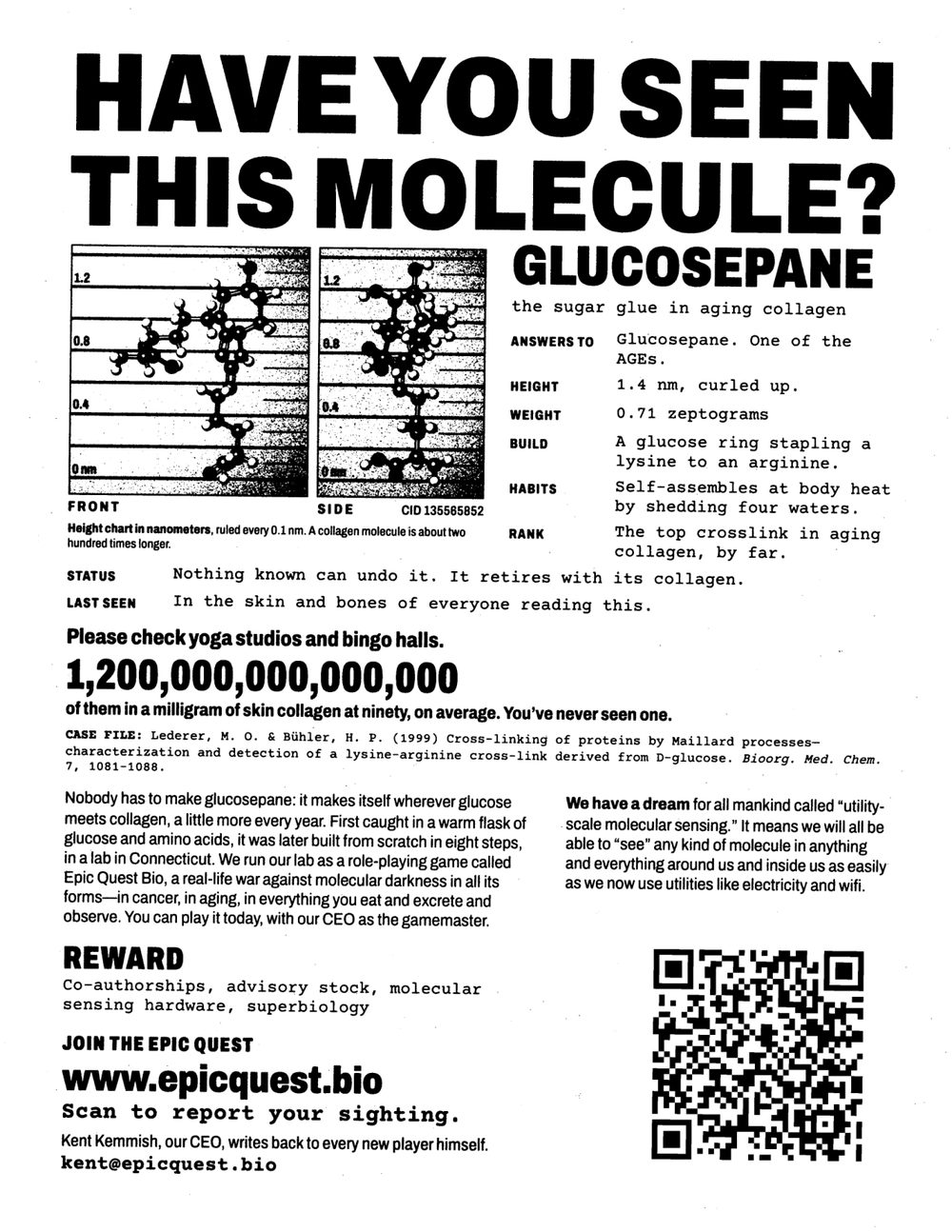
This is the photocopied wanted poster for Glucosepane, No. 109 of the exotic forty. They were made for noticeboards around Boston, Cambridge and the rest of the east coast.
Found one? Scan its QR code with your phone. If you're a signed-in player, the sighting goes on your record with +1 XP.
Not a player yet? Join the Epic Quest: the real role-playing game of Molecular Reality, a nanopore lab, with the CEO as gamemaster.