Molecular information ratchet
In The Demon Job he's the Demon: a ring on a rod that really can sort molecules, as long as somebody pays to wipe his notes.
Molecular information ratchet plays The Demon in The Demon Job
A detective made of water, a client who was the first molecule there ever was, and a demon who says he can sort for nothing.
Watch from 8:51, where The Demon first appears → or from the start
Booking photographs
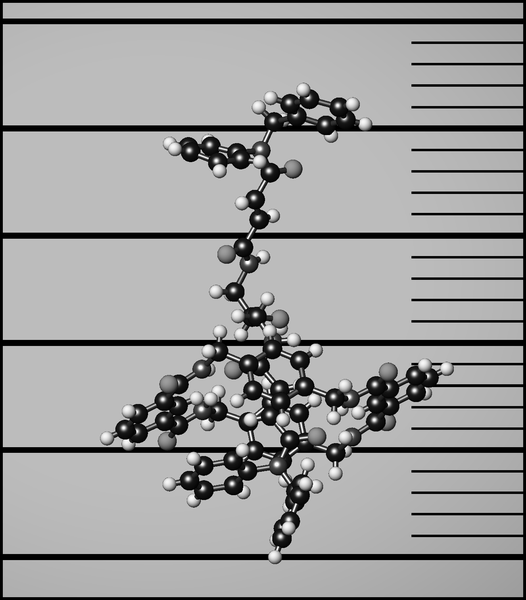
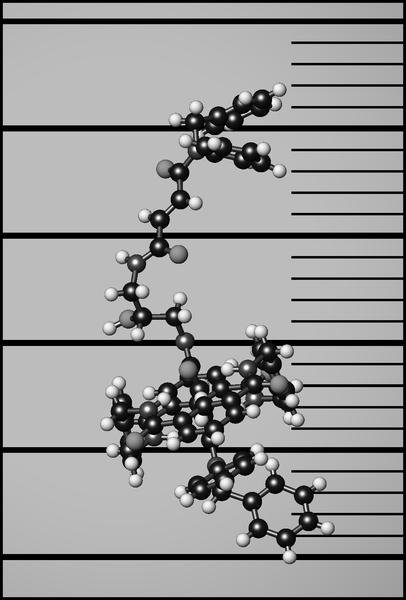
The suspect, from its real atomic coordinates. Drag to turn it. Height chart in nanometers, ruled every 0.1 nm. The paper this is printed on is tens of thousands of times thicker.
Rap sheet
- Answering to the name Maxwell's demon (the comparison is in the 2007 paper's own abstract).
- Biasing: 67 of every 100 rings trapped on the side the catalyst picked, where chance says 50.
- Shape-shifting: left- or right-handed, depending on where its ring is.
- Running on fuel: the gate is a chemical reaction, and every closing uses up reagent.
- An outstanding debt: what every demon owes, kT ln 2 for each bit it forgets.
- Answers to
- Maxwell’s demon. Unlike the original, needs fuel.
- Height
- 2.2 nm, standing on its axle.
- Weight
- 1.9 zeptograms, ring included.
- Topology
- A ring on an axle, not bonded to it. Stoppers keep it on.
- Habits
- Its ring hops between two identical stations, four hydrogen bonds at each.
- Marks
- Left- or right-handed, depending on where its ring is.
- Method
- A chiral catalyst shuts a gate behind the ring, sooner on one side. Swap its hand and the bias flips.
- First seen
- In Maxwell’s 1867 thought experiment. In a flask, 2008.
- Last seen
- In a colorless crystal at 173 kelvin, in a lab in Scotland.
- M.O.
- The ring hops between two identical fumaramide stations, four hydrogen bonds at each. A chiral catalyst closes a gate between them, by benzoylating a hydroxyl, faster when the ring is on one side, trapping it there. Swap the catalyst's hand and the bias flips.
- Associates
- its older sibling, the 2007 light-driven ratchet; a chiral catalyst, the inside man; Maxwell's demon (1867); Landauer's principle (1961)
- Priors
- A thought experiment in 1867; a light-driven version in 2007; this chemically driven version in 2008, crystallized at 173 K.
of every 100 get trapped on the side the catalyst picked.
Chance says 50. You’ve never seen one.
“Every bit you remember, you'll one day have to forget. That's when the Law collects.” — Keltar, on the case
Case notes: the bill
Szilard (1929) put a price of k log 2 of entropy on a demon's measurement. Landauer (1961) moved the price to forgetting: resetting a bit must supply '0.6931 kT per restored bit to the surroundings'. Bennett (1982) closed the case: the irreversible step 'is not the making of a measurement ... but rather the logically irreversible act of erasing the record of one measurement to make room for the next.' In 2012 a single silica bead, two micrometers across, in a laser double-well trap showed 'the mean dissipated heat saturates at the Landauer bound in the limit of long erasure cycles.'
kT ln 2 is 2.87 zeptojoules at 300 K, or 2.97 at body temperature. The ratchet in the mugshot pays in a different coin. Its gate is closed by an irreversible chemical reaction, a benzoylation, catalysed faster on one side by a chiral catalyst, so every trapped ring costs reagent. Its 2007 sibling ran on light. Neither one is free, and neither paper says otherwise.
Sources
- Alvarez-Pérez M. et al. 2008, J. Am. Chem. Soc. 130:1836-1838, doi:10.1021/ja7102394
- Serreli V. et al. 2007, Nature 445:523-527, doi:10.1038/nature05452
- Szilard L. 1929, Z. Phys. 53:840-856, doi:10.1007/BF01341281
- Landauer R. 1961, IBM J. Res. Dev. 5:183-191
- Bennett C. H. 1982, Int. J. Theor. Phys. 21:905-940, doi:10.1007/BF02084158
- Bérut A. et al. 2012, Nature 483:187-189, doi:10.1038/nature10872
The interrogation room

Keltar is an AI character. He sticks to the file; the conversation is saved and Kent, the CEO, can read it.
The poster on the street
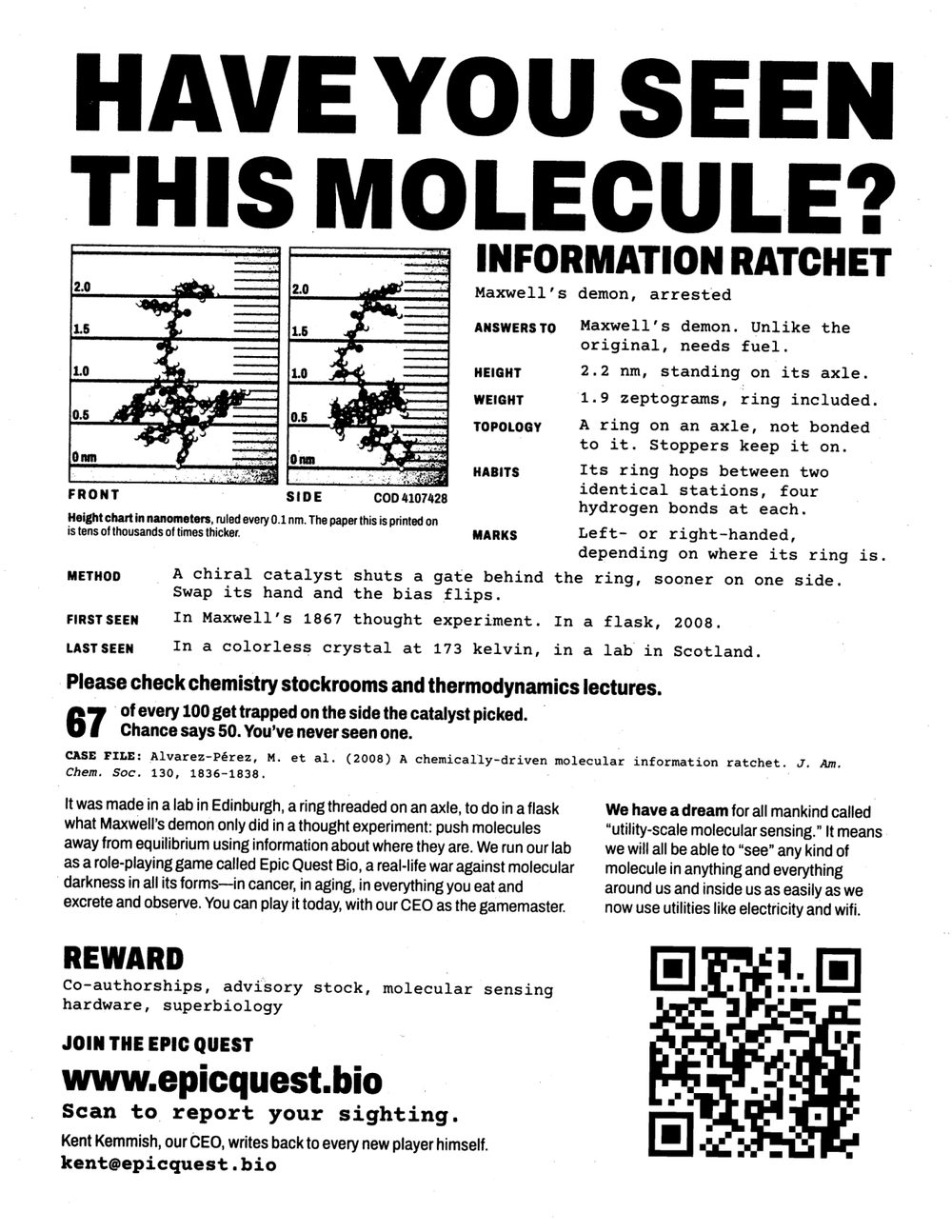
This is the photocopied wanted poster for Molecular information ratchet, No. 122 of the exotic forty. They were made for noticeboards around Boston, Cambridge and the rest of the east coast.
Found one? Scan its QR code with your phone. If you're a signed-in player, the sighting goes on your record with +1 XP.
Not a player yet? Join the Epic Quest: the real role-playing game of Molecular Reality, a nanopore lab, with the CEO as gamemaster.