Phi29 portal motor
In The Demon Job he's the Muscle: one of the strongest motors in biology, who packs DNA into virus heads for ATP and watches the Fat Man's door at night.

Phi29 portal motor plays The Muscle in The Demon Job
A detective made of water, a client who was the first molecule there ever was, and a demon who says he can sort for nothing.
Watch from 16:56, where The Muscle first appears → or from the start
Booking photographs
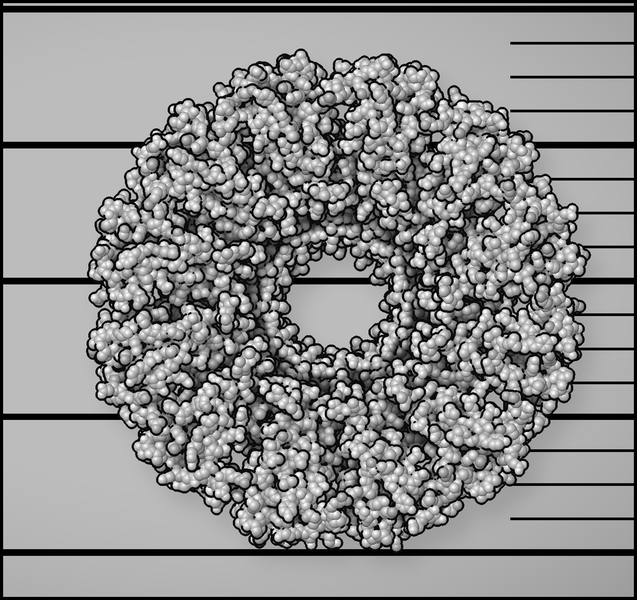
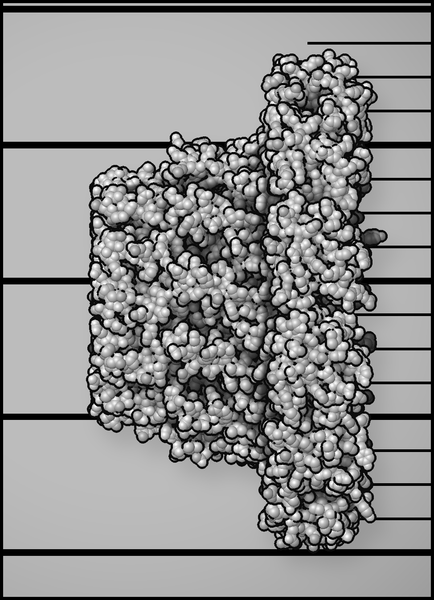
The suspect, from its real atomic coordinates. Drag to turn it. Height chart in nanometers, ruled every 1 nm. Front: down its 3.5 nm DNA channel. The virus head it fills is 42 by 54 nm.
Rap sheet
- Hauling under load: keeps packaging DNA against up to 57 piconewtons, on average (2001).
- Overstuffing: a 6.6-micrometer genome into a 42 by 54 nanometer head, near crystal-tight.
- Paying in installments: 10 base pairs a cycle, in four strokes of 2.5, for five ATP.
- Suspicion of spinning, since dropped: a 2007 test excluded rotation with better than 99% probability.
- Carrying a passenger: of its five ATPases, one burns its ATP every cycle and never pulls.
- Answers to
- Phi29 portal motor. Pictured: its core, the connector.
- Height
- 14.8 nm, on its edge.
- Weight
- 0.72 attograms (the ring).
- Build
- Twelve proteins in a propeller-shaped ring around a 3.5 nm channel.
- Strength
- Pulls DNA in against up to 57 pN.
- Habits
- Crams DNA 120 times longer than the head into it, near-crystal tight.
- Associates
- A ring of five RNAs and a ring of five ATPases that burn the fuel.
- Suspected
- Of spinning, in its first two crystal papers. Cleared by a 2007 test, over 99% sure.
- Last seen
- In a soil bacterium, reeling DNA into a new virus head.
- M.O.
- In an infected soil bacterium, the motor docks on an empty virus head and feeds the 19,282-base-pair genome through its 3.5 nm channel. Its five ATPases all load and burn ATP each cycle; after a pause, four of them fire a burst of four 2.5-base-pair strokes, and the fifth only regulates.
- Associates
- Bacillus subtilis, the soil bacterium it infects; a ring of five prohead RNAs; a ring of five ATPases; phage T4's packaging motor, a rival at over 60 pN
- Priors
- Crystal structures in 2000 and 2002 (both proposed a rotating ball-race); stall force measured with optical tweezers in 2001; rotation excluded in 2007; the 10-base-pair burst of four 2.5-base-pair strokes in 2009; the fifth subunit that burns ATP without pulling, in 2012.
base pairs it reels into each new virus head, 2.5 at a time.
You’ve never seen one.
“Strong, fast and honest. Every step, a coin; every coin, a little heat.” — Keltar, on the case
Case notes: the motor's books
Bulk measurements found the motor burns five ATP for every ten base pairs it packages. Optical tweezers saw something that looked different: a pause, then a burst of four strokes of 2.5 base pairs each. A 2012 study reconciled the two. All five subunits of the ATPase ring bind and burn ATP every cycle, but only four pull; the fifth has a regulatory job.
Near its stall force of 57 piconewtons, a 2.5-base-pair stroke (0.85 nm) is at most 48 pN nm of work, about 11 kT. One ATP in a working cell is worth about 50 to 60 kJ/mol, or 83 to 100 pN nm. So at best roughly half of each stroke's coin becomes work and the rest becomes heat. At stall nothing actually moves, so 48 is a ceiling; no paper gives a measured efficiency. One genome is 19,282 base pairs, which comes to about 9,600 ATP per virus head.
Sources
- Smith D. E. et al. 2001, Nature 413:748-752, doi:10.1038/35099581
- Moffitt J. R. et al. 2009, Nature 457:446-450, doi:10.1038/nature07637
- Chistol G. et al. 2012, Cell 151:1017-1028, doi:10.1016/j.cell.2012.10.031
- Hugel T. et al. 2007, PLoS Biol. 5:e59 (rotation excluded)
- Milo R. & Phillips R., Cell Biology by the Numbers, Table 1 (ATP free energy; BioNumbers 101964, 101944)
The interrogation room

Keltar is an AI character. He sticks to the file; the conversation is saved and Kent, the CEO, can read it.
The poster on the street
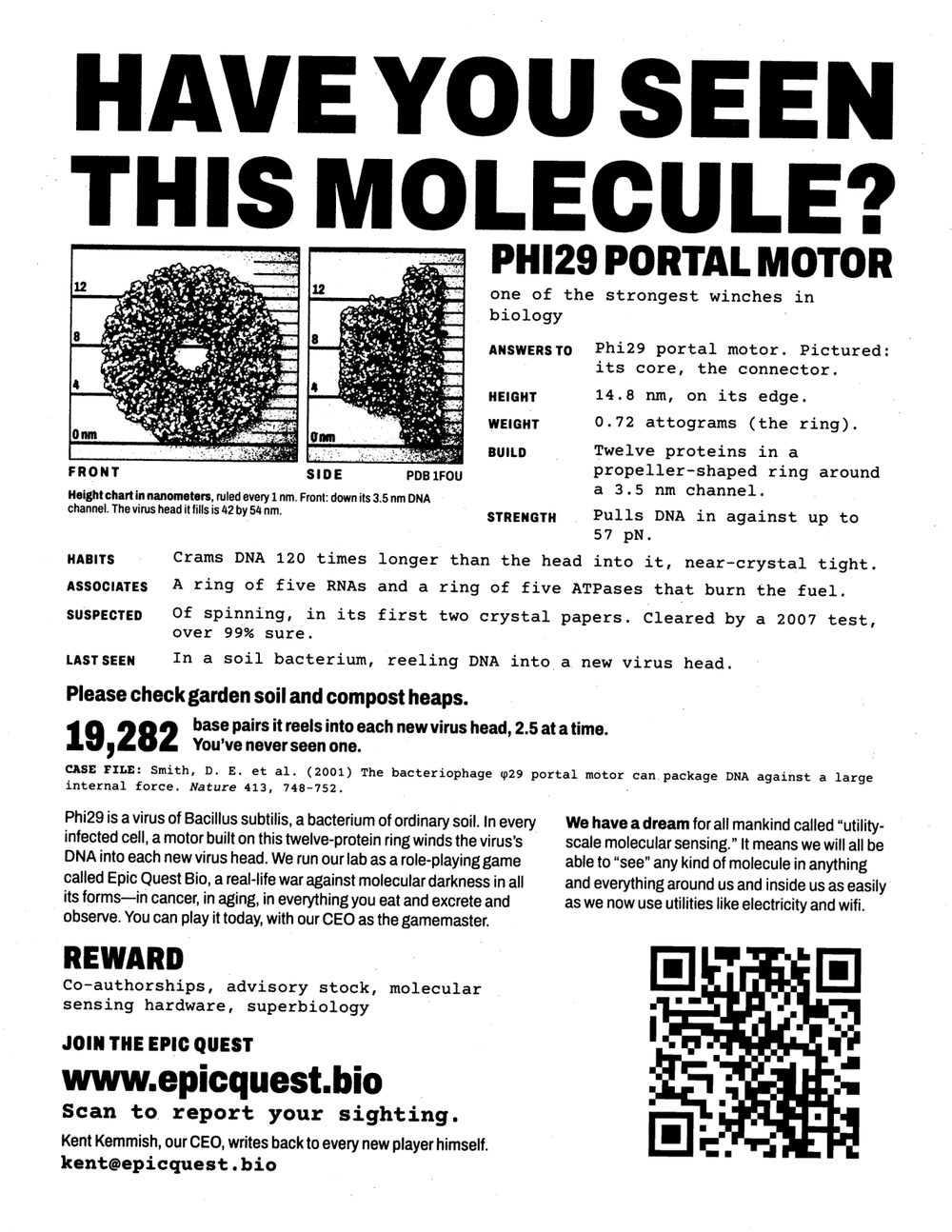
This is the photocopied wanted poster for Phi29 portal motor, No. 136 of the exotic forty. They were made for noticeboards around Boston, Cambridge and the rest of the east coast.
Found one? Scan its QR code with your phone. If you're a signed-in player, the sighting goes on your record with +1 XP.
Not a player yet? Join the Epic Quest: the real role-playing game of Molecular Reality, a nanopore lab, with the CEO as gamemaster.