Helium dimer
Two helium atoms, a noble gas with no reason to bond, leave a nozzle together and stay together, barely: one bound state, 139 nano-electronvolts of commitment, and most of their time spent where classical physics says they cannot be.
Booking photographs
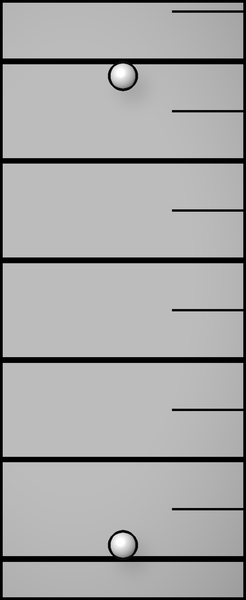
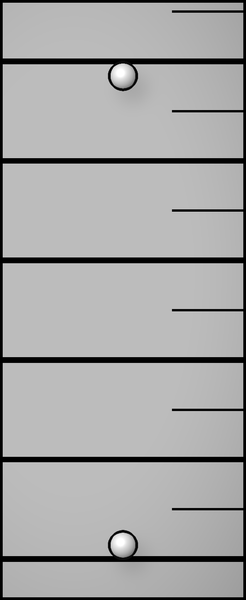
The suspect, from its real atomic coordinates. Drag to turn it. Height chart in nanometers, ruled every 0.5 nm. Drawn at its average length; the bond in a hydrogen molecule is a sixty-fourth as long.
Rap sheet
- Consorting while noble: a closed-shell gas, bound by the van der Waals force alone.
- Trespassing in the classically forbidden region, 80% of the time.
- Holding a bond so weak that 32 million of them pooled would match one hydrogen molecule.
- Refusing to rotate: no bound rotational states; one quantum of angular momentum ends it.
- Using the title of its own arrest report as an alias ('The weakest bond', 1993).
- Answers to
- He2. “The weakest bond,” per its first paper.
- Height
- About 5 nm, on average. Caught as tall as 25.
- Weight
- 13 yoctograms: two He atoms, to 16 decimal places.
- Build
- Two atoms and no stick. Mostly gap.
- Habits
- Classical physics says it can’t be longer than 1.4 nm. It is, 80% of the time.
- Weakness
- Spin. One quantum of rotation breaks it.
- Associates
- The helium trimer, whose Efimov state was predicted in 1970 and seen in 2015.
- First seen
- In 1993, in a helium jet at a thousandth of a kelvin, after long doubt.
- Last seen
- Flying apart under a laser, one pair at a time, in a lab in Frankfurt.
- M.O.
- Forms only where helium is cold enough to be coaxed: gas at 8 kelvin forced through a five-micron nozzle into vacuum, where a few atoms pair up on the way out. A 100 nm grating then sorts the couples from the singles by their de Broglie wavelength. The pair has one bound vibrational state, a potential well 0.95 meV deep at 0.3 nm, and a wavefunction that leaks out past 25 nm.
- Associates
- the helium trimer, whose Efimov state was predicted in 1970 and observed in 2015; helium-3, whose 3He4He pair never holds together at all (too much zero-point energy); the hydrogen molecule, 64 times shorter and 32 million times more committed
- Priors
- Its existence was argued over for decades: whether the zero-point energy exceeded the depth of the well. First seen in 1993 in a helium jet near a millikelvin; sorted by mass with a transmission grating in 1994; bond length measured at 52 plus or minus 4 angstroms in 2000; its quantum halo imaged in 2016.
of them, bonds pooled, to match the one bond in a hydrogen molecule, give or take.
You’ve never seen one.
“Best surveillance job I ever had. The suspects were never closer than three angstroms, and mostly nowhere they were allowed to be.” — Keltar, on the case
Field notes: the arithmetic of a halo
A bound state this shallow is a 'quantum halo': the binding energy E sets how fast the wavefunction dies off outside the well, as exp(-kappa R) with kappa = sqrt(2 mu E) / hbar. For 4He2, E = 138.9 neV and the reduced mass mu is half a helium atom, which gives a probability density that falls by e every 43 angstroms. Integrate that tail from the classical turning point (13.6 angstroms) outward and you get 80%: the share of the time the two nuclei spend where a classical particle with that energy could never go. The 2016 experiment measured that exponential decay over two orders of magnitude, out to 250 angstroms.
The mean separation comes out at 47.13 angstroms in the best theory (2017; submillikelvin uncertainties); the one direct measurement, by grating diffraction in 2000, gave 52 plus or minus 4. The poster draws the two atoms at the theoretical average, because a halo has no fixed shape to draw.
Its binding energy, 138.9 neV, is 1.6 millikelvin in temperature units. The hydrogen molecule's bond is 4.4779 eV, which is why it takes about 32 million helium-dimer bonds, pooled, to match one.
Sources
- Zeller et al. 2016, Proc. Natl. Acad. Sci. U.S.A. 113:14651-14655, doi:10.1073/pnas.1610688113
- Przybytek et al. 2017, Phys. Rev. Lett. 119:123401, doi:10.1103/PhysRevLett.119.123401
- Grisenti et al. 2000, Phys. Rev. Lett. 85:2284-2287, doi:10.1103/PhysRevLett.85.2284
- Luo et al. 1993, J. Chem. Phys. 98:3564-3567 ('The weakest bond')
- Kunitski et al. 2015, Science 348:551-555 (the trimer's Efimov state)
- NIST Chemistry WebBook, H2 constants (D0 = 4.4779 eV, r_e = 0.74144 A)
The interrogation room

Keltar is an AI character. He sticks to the file; the conversation is saved and Kent, the CEO, can read it.
The poster on the street
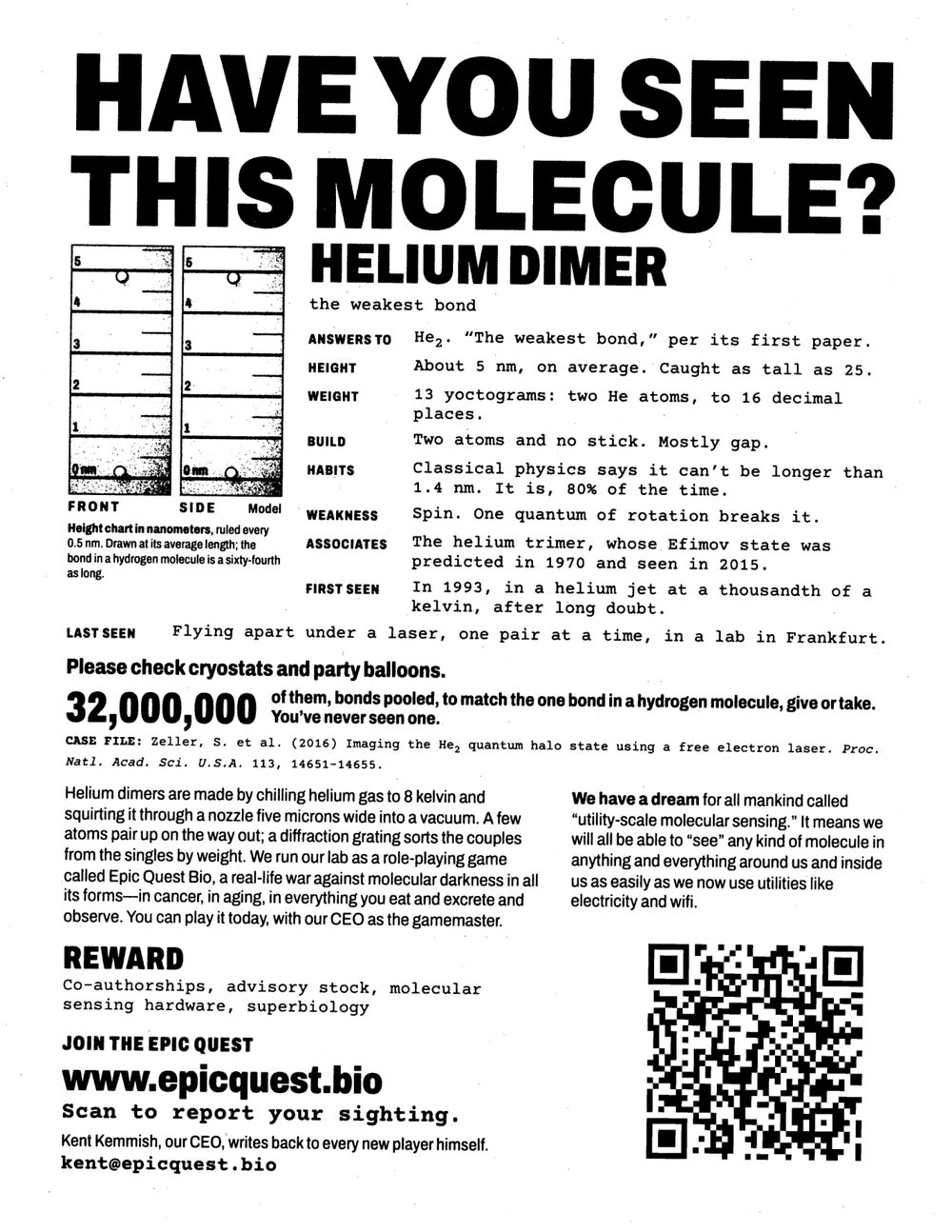
This is the photocopied wanted poster for Helium dimer, No. 103 of the exotic forty. They were made for noticeboards around Boston, Cambridge and the rest of the east coast.
Found one? Scan its QR code with your phone. If you're a signed-in player, the sighting goes on your record with +1 XP.
Not a player yet? Join the Epic Quest: the real role-playing game of Molecular Reality, a nanopore lab, with the CEO as gamemaster.