Gas vesicle
In The Demon Job he's the Float: a hollow protein shell full of air that floats without pumping or choosing anything, and can see the whole shelf.

Gas vesicle plays The Float in The Demon Job
A detective made of water, a client who was the first molecule there ever was, and a demon who says he can sort for nothing.
Watch from 18:02, where The Float first appears → or from the start
Booking photographs
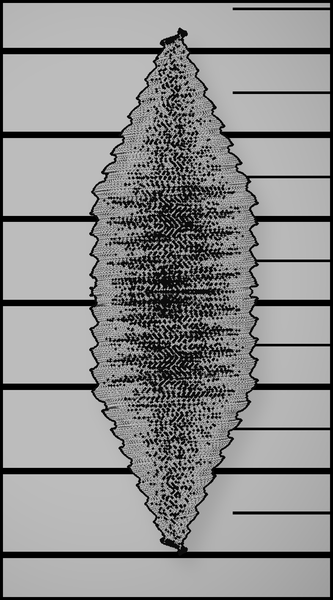
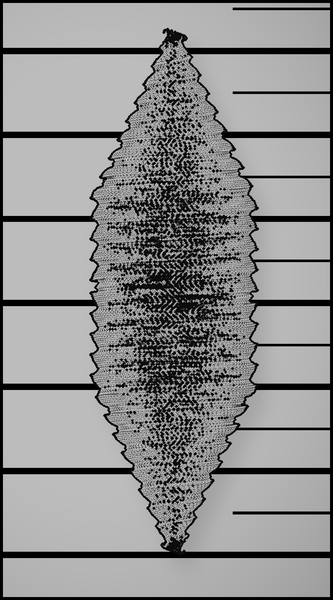
The suspect, from its real atomic coordinates. Drag to turn it. Height chart in nanometers, a line every 10 nm. Mugshot: a model, one dot per amino acid. A party balloon is about seven million times wider.
Rap sheet
- Floating without a pump: gas diffuses in and out on its own.
- Keeping water out with a greasy lining and slits 0.24 to 0.38 nm wide.
- Bracing its wall at 54 degrees, near the 54.7-degree 'magic angle' of a pressurized cylinder.
- Collapsing under a hammer blow on a cork, 1895.
- Travelling in crowds: packed together, they were once mistaken for one big 'gas vacuole'.
- Answers to
- Gas vesicle. Formerly “gas vacuole.” Travels in crowds.
- Height
- 125 nm, standing on one tip. 40 nm wide.
- Weight
- 20 attograms. Its air: 0.07 zeptograms.
- Build
- 1,730 copies of one small protein, in a spiral. Wall: 2 nm.
- Marks
- Hydrogen bonds at 54° to its axis, near the “magic angle” of 54.7°.
- Habits
- Gas gets in through slits 0.24 to 0.38 nm wide. Water can’t: the lining is greasy.
- Suspected
- Of growing at its seam, where its two half shells meet head to head.
- First popped
- In 1895: a botanist hammered the cork on a bottle of lake scum. It sank.
- Last seen
- Floating blue-green bacteria to the top of a lake, in the scum.
- M.O.
- Bacteria and archaea build hollow cylinders from one small protein, spiraling into ribs and capped with cones. Gas wanders through the slits until the inside matches the gas dissolved outside; water can't follow. To sink, a cell stops making them, or lets pressure collapse them.
- Associates
- cyanobacteria in lake scum; Bacillus megaterium, whose genes built the one pictured (in E. coli); salt-loving archaea; a hammer, 1895
- Priors
- Popped in 1895 by a botanist with a hammer; seen as stacks of hollow cylinders under the electron microscope in the 1960s; a full structure by cryo-EM in 2023.
molecules of air inside the one pictured: fewer than the 1,730 proteins in its wall.
You’ve never seen one.
“Free, because it never chooses.” — Keltar, on the case
Case notes: what floating costs
The wall is highly permeable to gases. Gas diffuses in and out until there is no pressure difference, and nothing is pumped. Equilibrium costs nothing to keep, and no work can be extracted from it.
The bill comes earlier, in protein. For a cyanobacterium to fill a tenth of its volume with gas, about 7.2% of all the protein it makes must be gas-vesicle protein. Cells rise and sink by making new vesicles or by letting turgor pressure collapse old ones. That is what the 1895 hammer did to a bottle of them.
Sources
- Huber S. T. et al. 2023, Cell 186:975-986.e13, doi:10.1016/j.cell.2023.01.041
- Walsby A. E. 1994, Microbiol. Rev. 58:94-144
- Shapiro M. G. et al. 2014, Nat. Nanotechnol., doi:10.1038/nnano.2014.32
- Oren A. 2012, Life 3:1-20 (citing Walsby)
The interrogation room

Keltar is an AI character. He sticks to the file; the conversation is saved and Kent, the CEO, can read it.
The poster on the street
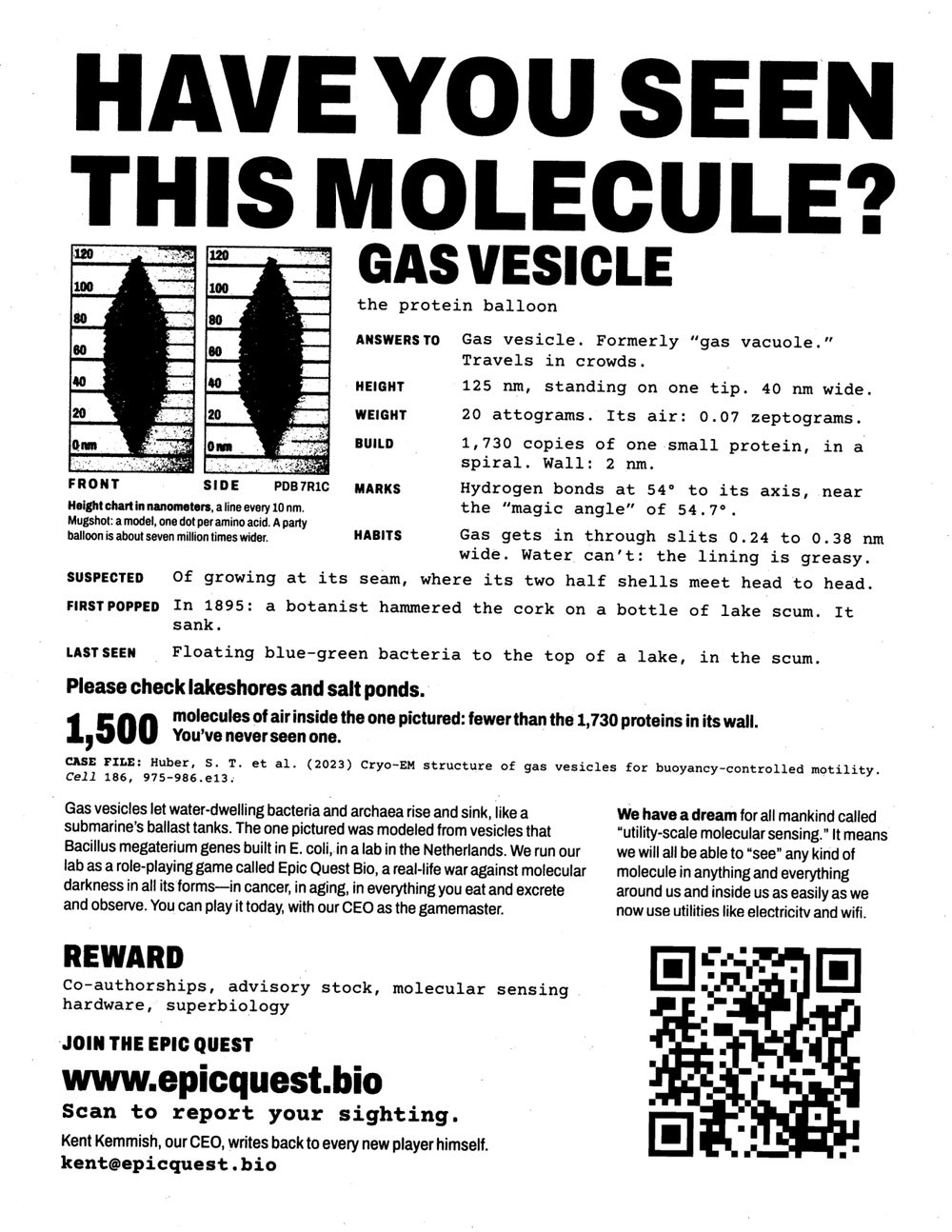
This is the photocopied wanted poster for Gas vesicle, No. 126 of the exotic forty. They were made for noticeboards around Boston, Cambridge and the rest of the east coast.
Found one? Scan its QR code with your phone. If you're a signed-in player, the sighting goes on your record with +1 XP.
Not a player yet? Join the Epic Quest: the real role-playing game of Molecular Reality, a nanopore lab, with the CEO as gamemaster.